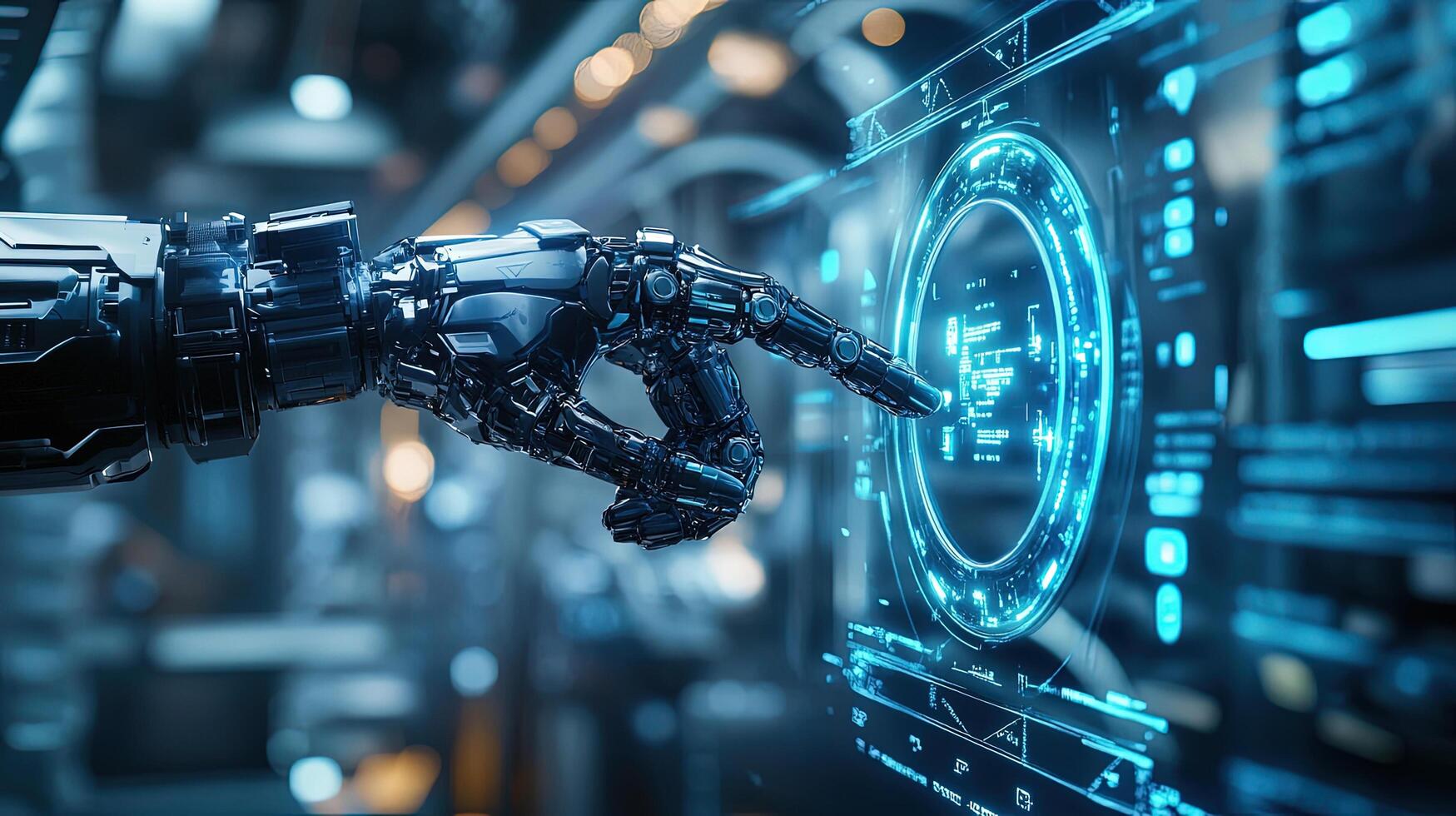
In every economic era, a single foundational technology emerges that does not just improve old industries but actively creates new ones. In the 19th century, it was the steam engine; in the 20th, it was the microchip. Today, Artificial Intelligence (AI) is that foundational technology. AI's ability to learn, predict, and generate is the driving innovation behind a new set of "future industries"—sectors that exist today but whose enormous potential is just beginning to be realized.
These industries are not just "AI-enhanced"; they are "AI-native." Their entire business model is predicated on AI's unique power to solve problems that were, until now, impossible.
1. Future Industry: Autonomous Mobility
The transportation industry is ancient, but the autonomous mobility industry is brand new. This emerging sector, encompassing autonomous trucking and "robotaxi" fleets, is entirely driven by AI innovation.
The AI Innovation: The "driver" in these vehicles is a sophisticated AI system. This is not a simple "cruise control" but a complex brain that relies on "sensor fusion"—processing a constant, 360-degree stream of data from LiDAR, radar, and cameras. The AI model's role is to identify and predict the behavior of everything in its environment, from a pedestrian stepping off a curb to a car braking two vehicles ahead.
Today's Impact: While still in its early stages, this AI-driven industry is no longer science fiction. Autonomous trucking fleets are already operating on highways, solving labor shortages and optimizing fuel. Robotaxi services are actively picking up passengers in several major cities. The entire "transportation-as-a-service" model is a future industry being built today, and its existence is 100% dependent on AI.
2. Future Industry: AI-Powered Biotechnology
The pharmaceutical industry has historically operated on a model of slow, expensive, and high-failure "trial and error" discovery. AI is creating an entirely new, parallel industry of "AI-first" biotechnology that operates on a model of intelligent design.
The AI Innovation: This new industry is driven by two AI breakthroughs. First, predictive models (like AlphaFold) can now accurately map the 3D shape of proteins, the "locks" that cause diseases. Second, generative AI is used for "de novo drug design." Scientists can now define a disease target, and the AI will generate a novel, perfect "key"—a molecular structure—from scratch.
Today's Impact: This "in silico" (computational) design process is a game-changer, slashing the initial drug discovery phase from years to months. Today, a significant portion of new drugs entering the development pipeline are being discovered using AI. This has also given rise to the industry of "personalized medicine," where AI can analyze a single patient's unique genomic data to design bespoke therapies, creating a market for treatments tailored to an individual.
3. Future Industry: General-Purpose Robotics
For 50 years, industrial robots have been "dumb" tools—caged, bolted to the floor, and programmed for one repetitive task. AI is creating an entirely new industry of "general-purpose" robots, often in humanoid form.
The AI Innovation: The revolutionary leap is the "AI brain," or "embodied AI." These robots are not programmed for a single task; they are trained in virtual "digital twin" environments. Using AI (specifically reinforcement learning and computer vision), they learn to navigate dynamic human spaces, identify objects, and understand natural language commands.
Today's Impact: If 2024 was the year of "talking AI" (chatbots), 2025 is the year of "walking AI." Billions of dollars are being invested in this new industry. These AI-powered humanoid robots are moving out of the lab and into their first pilot programs in warehouses and factories, where they are learning to collaborate with humans and perform a variety of tasks, heralding the arrival of a new, intelligent robotic workforce.
4. Future Industry: Intelligent Climate Tech
The global challenge of climate change has created the need for a new industry focused on decarbonization and grid management. AI is the enabling technology that makes this industry viable at a large scale.
The AI Innovation: AI's unique strength is in optimizing complex, variable systems. This is being applied to create two new sectors:
Virtual Power Plants (VPPs): A VPP is an entirely new, AI-driven industry. The AI acts as a central "control system" that connects thousands of "distributed" energy assets—like rooftop solar panels, home batteries, and EV chargers. The AI aggregates all these small sources and "dispatches" them to the grid as a single, large, clean power plant.
New Materials Discovery: AI platforms are being used to create another new R&D industry: the accelerated discovery of "green" materials. AI can run thousands of simulations to discover new molecular compounds for better batteries, more efficient solar panels, or new materials that can capture carbon directly from the air.
Today’s Future Industries Driven by AI Innovation
Cryptofor Team
•
September 28, 2025